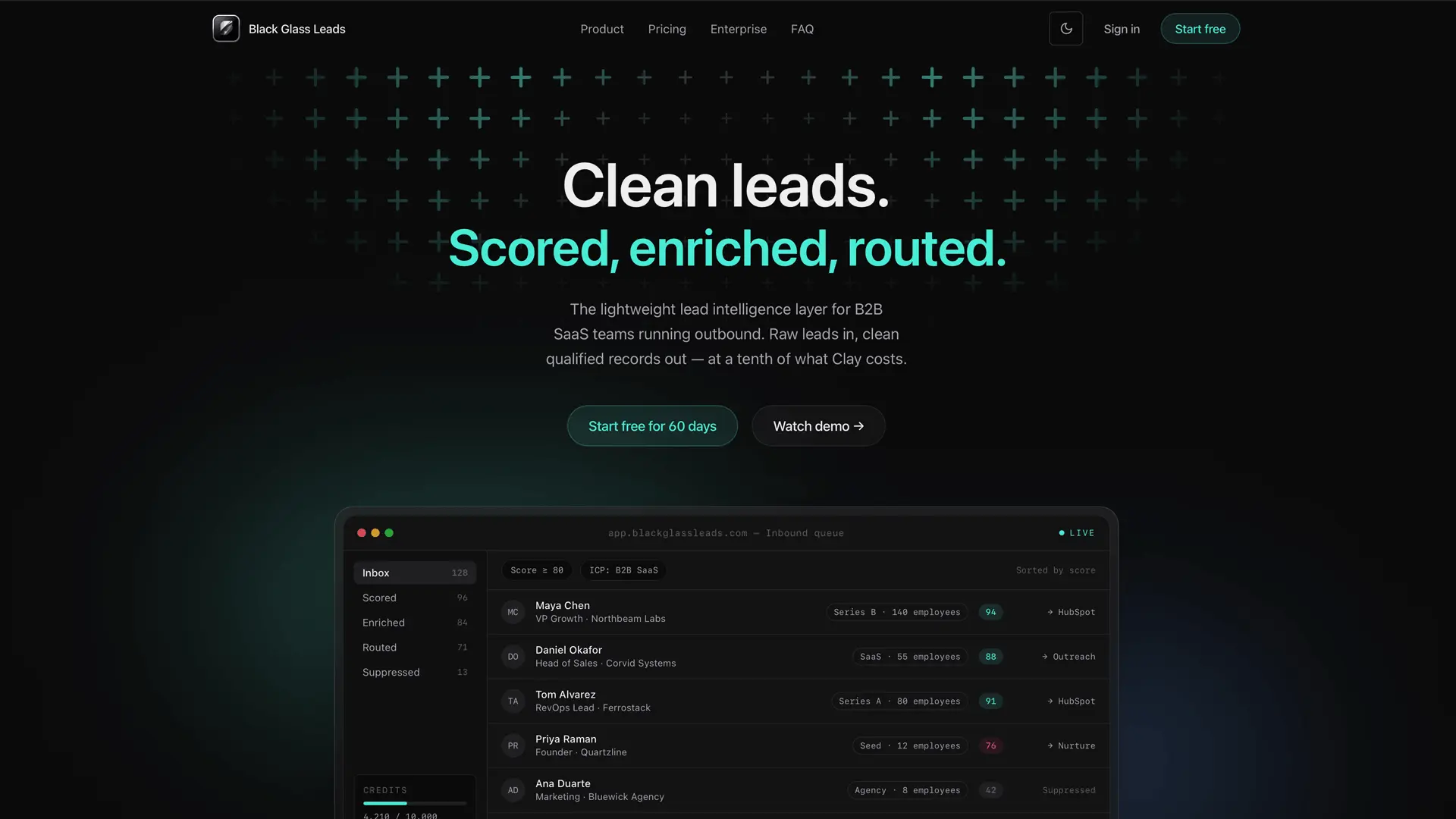
The product
Black Glass Leads connects lead capture, qualification, enrichment, and the work that follows. I created the product as an independent founder, owning its positioning, UX and UI, and full-stack implementation.
The central design question is simple: how do you help someone move from a collection of raw records to leads they can evaluate and act on?
My role
I work across product definition, interface design, application development, and ongoing operation. The application uses Nuxt and Vue, with TypeScript and Cloudflare infrastructure.
That breadth matters because the experience depends on the data pipeline. An interface cannot make an incomplete record trustworthy just by presenting it well. The product has to communicate what it knows and support the next useful action.
Designing around the workflow
The experience connects four related jobs:
- Capture. Bring lead information into the product through a usable entry point.
- Qualify. Evaluate how the available information fits the purpose of the workflow.
- Enrich. Add the context needed to make a record more useful.
- Act. Carry the resulting information into the team’s next step.
My design work focuses on keeping those stages understandable while accounting for the underlying processing and data-handling requirements.
Cost is a product constraint
I track usage and cost at very fine precision to support accounting, budgeting, and decisions about where to reduce spend. It is the same discipline I apply to my internal AI platform work.
The useful question is what a completed workflow costs, including the provider work required to produce it. That calls for clear cost records and reconciliation, alongside the experience customers see.
What this project demonstrates
Black Glass Leads brings together product judgment, design, full-stack engineering, and the ongoing responsibility of operating an independent product. It is a place where I own both the experience and the decisions behind it.